
Korean Language Learning Comics
- Image
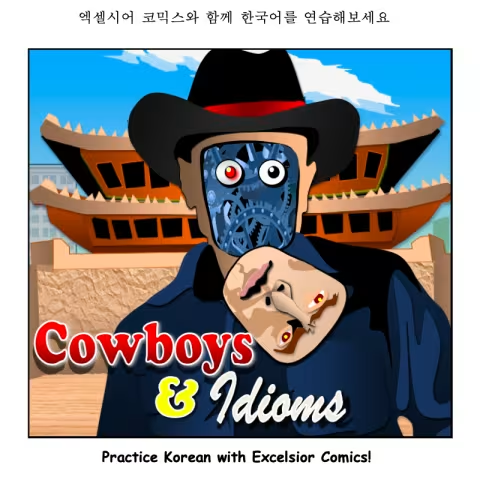
Comics are a fun way to engage with, and learn, a new language. These comics place words and phrases in a vivid settings.
Lexical Aspects:
Practice common Korean morphemes that convey the same semantic idea across different Korean words: Morphemes
Practice conjugations of common Korean verbs: Conjugations
Practice tenses of common Korean verbs: Tenses
Grammatical Aspects:
Practice some productive Korean multiword constructions: Constructions
Practice Korean with some short comic stories: Tales
Practice some useful Korean phrases: Themes
Mixed Lessons (lexical and grammatical):
These lessons mix elements of the lexical and grammatical comics above:
Large Language Models and Generative AI
- Image
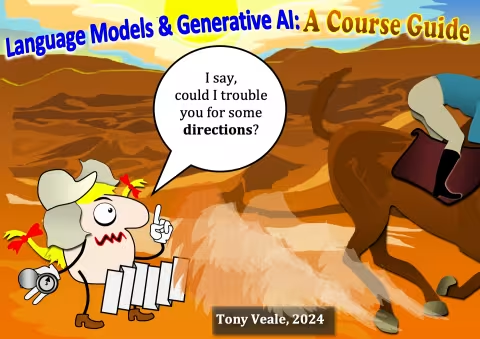
Explore Large Language Models (LLMs) and Generative AI with a set of illustrated flip book lectures.
You can view the catalogue and access specific lectures here. The course covers the following topics:
- Lecture 0 - Course Guide
- Lecture 1 - What is Language
- Lecture 2 - What is a Language Model
- Lecture 3 - Entropy and Perplexity
- Lecture 4 - Connectionism
- Lecture 5 - Vector Encodings
- Lecture 6 - Recurrent Neural Nets
- Lecture 7 - Tokenization
- Lecture 8 - Transformers
- Lecture 9 - CLIP embeddings
- Lecture 10 - Diffusion Models
- Lecture 11 - Masked Language Models
- Lecture 12 - Alignment I
- Lecture 13 - Alignment II
- Lecture 14 - Retrieval Augmented Generation
- Lecture 15 - Prompt Engineering
- Lecture 16 - Jailbreaking LLMs
- Lecture 17 - LLMs and Knowledge Graphs
- Lecture 18 - LLMs & OWL
Hand-Made By Machines
- Image
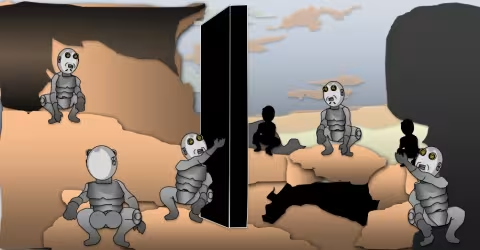
Can machines ever be truly creative? The success of Generative AI has certainly shifted the debate, despite a baleful tendency to use this new technology to produce "slop".
Hand-Made By Machines is a 2013 illustrated book that introduces the foundational concepts of the field of Computational Creativity.
The book, linked here as a downloadable PDF, explores these foundations by answering the following questions:
- What is (human) creativity? Can we measure it?
- How does linguistic creativity work?
- Are there rules of creativity (can have a rule-breaking activity have rules of its own)?
- What does it mean for a creative artefact be "original" and "useful"?
- Is it productive to view creativity as a search process (as in good-old-fashioned AI)?
- Are there different kinds and scales of creativity (e.g., personal versus historical)?
- Is there an important difference between mere generation and true creativity?
- How does humorous creativity allow us to find sense in nonsense?
- How does the human mind foster creativity, but sometimes hinder creativity too?
- What are the most effective strategies for being creative, for humans or machines?
Your Wit Is My Command
- Image
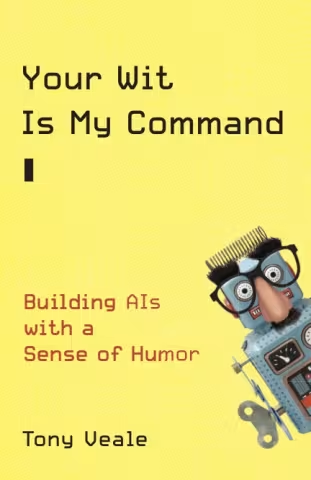
For much of its history, AI was a scientific discipline defined more by its portrayal in science fiction than by its actual technical achievements. Real AI systems are now catching up to their fictional counterparts, and are as likely to be seen in news headlines as on the big screen. Yet as AI outperforms people on tasks that were once considered yardsticks of human intelligence, one area of human experience still remains relatively unchallenged by technology: our sense of humour.
This is not for want of trying, as this book will show. The true nature of humour has intrigued scholars for millennia, but AI researchers can now go one step further than philosophers, linguists and psychologists once could: by building computer systems with a sense of humour, capable of appreciating the jokes of human users or even of generating jokes of their own, we can turn academic theories into practical realities that amuse, explain, provoke and delight.
This book uses the concepts and achievements of AI to explore what it means to have a sense of humour, and moreover, to understand what it is to not have a sense of humour. It challenges the archetype of the rigidly humourless machine in popular culture, to celebrate what science fiction gets right and to learn from what it frequently gets wrong. It makes a case for the necessity of a truly computational understanding of humour, to better understand ourselves and to better construct machines that are more flexible, more understanding, and more willing to laugh at their own limitations.
Welcome to the Best of Bot Worlds
- Image
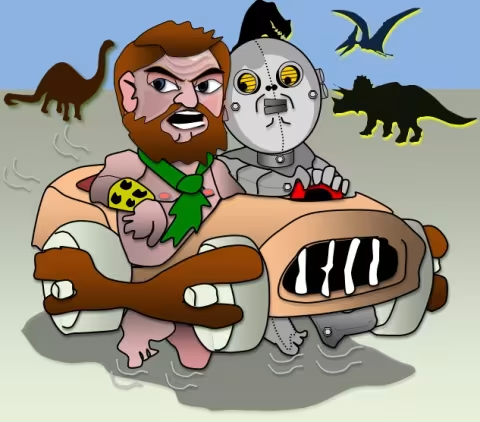
This site looks at AI (both old-fashioned symbolic and new-fangled generative AI).